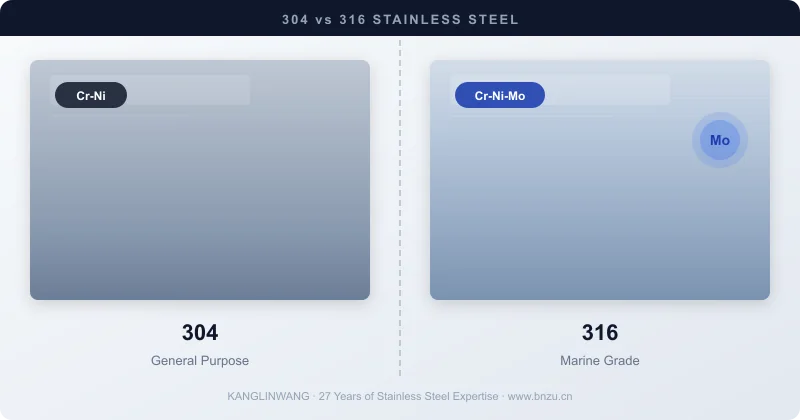
We get this question at least three times a week: “Do I really need 316, or will 304 work?” And honestly, half the time the answer is — you’re overthinking it. The other half? You’re about to make a mistake that’ll cost you a fortune in replacements.
Here’s the thing. 304 and 316 are both excellent stainless steels. They weld well, they form well, they look great. But they are not interchangeable in every situation, and picking the wrong one has bitten more than a few project managers we know.
We’ve been cutting, bending, and shipping both grades for 27 years out of Guangdong. This isn’t a textbook breakdown — it’s what we’ve learned from watching projects succeed and, occasionally, fail.
What’s Actually Different (Chemically Speaking)
Strip away the surface and both are chromium-nickel austenitic steels. The real difference comes down to one element: molybdenum. 316 has 2–3% of it. 304 has none.
| Element | 304 | 316 |
|---|---|---|
| Chromium | 18–20% | 16–18% |
| Nickel | 8–10.5% | 10–14% |
| Molybdenum | — | 2–3% |
| Carbon | ≤ 0.08% | ≤ 0.08% |
| UNS Number | S30400 | S31600 |
That molybdenum is doing the heavy lifting. It toughens up the passive oxide layer on the steel’s surface, making it much harder for chlorides to sneak through and start pitting. This is why people call 316 “marine grade” — though technically, even 316 has its limits in actual seawater.
Corrosion Resistance — Where It Really Matters
In a clean, dry office or a kitchen? Both grades are overkill. You’ll never notice a difference. The gap shows up when things get hostile.
Stick with 304 when:
- The part lives indoors — appliances, countertops, elevator panels
- You’re making food equipment for non-acidic products
- It’s outdoor, but nowhere near the coast
- Storage tanks for clean water
- Budget matters and the environment is mild
Go with 316 when:
- You’re within sniffing distance of saltwater (we say 10 km to be safe)
- Chemicals are involved — processing, cleaning, storage
- Swimming pools, splash pads, anything with chlorine
- Pharmaceutical or biotech gear
- Acidic food lines — citrus, dairy, pickling, vinegar
- Textile dyeing or paper pulp equipment
That’s not an edge case. We’ve seen it happen repeatedly. If your project is near the coast, near a pool, or near anything with chlorine in the air — just use 316. The math never works out in your favor when you cheap out on the wrong grade.
Can You Tell Them Apart?
No. Not by looking, anyway. They’re both shiny, both silver, both feel the same in your hand. Even experienced fabricators can’t eyeball the difference. This is actually a real problem in the industry — we’ve heard stories (and seen test reports) of suppliers shipping 304 as 316 to pocket the markup.
Always, always ask for the mill test certificate. If they can’t produce one, walk away.
Mechanical Properties — Spoiler: They’re Basically the Same
| Property | 304 | 316 |
|---|---|---|
| Tensile Strength | 515 MPa | 515 MPa |
| Yield Strength | 205 MPa | 205 MPa |
| Elongation | 40% | 40% |
| Hardness | ≤ 201 HB | ≤ 217 HB |
| Magnetic? | No | No |
From a fabrication angle, your shop won’t know the difference. Same cutting parameters, same bending tools, same welding wire (though for 316, you’d use 316L filler to match). Don’t let anyone tell you 316 is “harder to work with” — it’s not.
The Money Question
316 runs about 15–25% more than 304, depending on where nickel and molybdenum prices are sitting that month. On a big order, that adds up.
But here’s how we frame it for our clients: don’t look at the per-kilo cost. Look at the replacement cost.
A 304 railing that pits out in two years near the coast? You’re paying for removal, new material, reinstallation, and probably a very unhappy client. A 316 railing that lasts 20 years in the same spot costs more upfront and exactly zero in regret.
Where Each Grade Typically Ends Up
Based on what we actually ship week after week, here’s the real-world breakdown:
| Application | Grade | Why |
|---|---|---|
| Kitchen sinks, counters | 304 | Cheap, safe, does the job |
| Indoor railings, elevator panels | 304 | No weather exposure |
| Outdoor railing — inland | 304 | Fine in most cities |
| Outdoor railing — coastal | 316 | Salt air eats 304 alive |
| Chemical tanks, pipes | 316 | Acids and chlorides |
| Dairy, beverage equipment | 316 | Lactic acid + CIP chemicals |
| Marine hardware | 316 | Obviously |
| Building façade — city | 304 | Pollution-resistant enough |
| Pool structures | 316 | Chlorine in the air |
| Heat exchangers | 316 | Heat + chemicals |
Surface Finishes — Same Options for Both
One thing people get confused about: the grade doesn’t limit your finish options. Both 304 and 316 come in the same surface treatments:
- 2B — the standard mill finish, smooth and slightly reflective
- No.4 / Hairline — that brushed look you see on elevators and kitchen appliances
- 8K Mirror — the high-shine finish for lobbies, retail, luxury projects
- Sandblasted — matte, even texture
- PVD Color — gold, black, bronze, rose gold, you name it
- Etched — custom patterns and textures
We do all of this in-house, so the lead time doesn’t change based on which grade you pick.
How to Make Sure You Got What You Paid For
This is the part nobody likes to talk about, but it matters. Grade substitution happens. We’ve had clients bring us “316” from other suppliers that tested out as 304 with a fancy certificate.
A few ways to protect yourself:
- Demand mill test certificates (MTC) — real ones, with EN 10204 3.1 certification showing the actual heat chemistry. Not photocopies. Not PDFs with no traceability.
- Check the molybdenum line — if the MTC says 0% Mo and the grade says 316, something’s off. Walk away.
- Use a PMI gun if you can — portable XRF analyzers check alloy composition in seconds. Any serious fabrication shop should have one.
- Buy from certified, traceable sources — ISO 9001 helps. So does knowing which mill the coil came from.
Frequently Asked Questions
Is 316 always better than 304?
No. 316 handles corrosion better because of the molybdenum, but 304 does the job fine in most indoor and general environments. No point paying more if you don’t need to.
Can I use 304 outdoors?
Yes, 304 works outdoors in most places. But if you’re near the coast, around pool chemicals, or dealing with industrial fumes, go with 316. We’ve seen 304 railings start pitting within a year in seaside projects.
How much more does 316 cost?
Usually 15–25% more, depending on nickel and molybdenum prices at the time. The gap widens and narrows with the metals market.
Which grade is best for food processing?
Both work. 304 is the standard pick for most food equipment. If you’re processing acidic stuff — citrus, dairy, pickling lines — or doing heavy chemical cleaning, 316 is worth the upgrade.
Still Not Sure Which Grade You Need?
Send over your drawings or project specs. Our engineering team will look at your environment, your budget, and your application — and give you a straight answer. No upselling. Quote back within 24 hours.